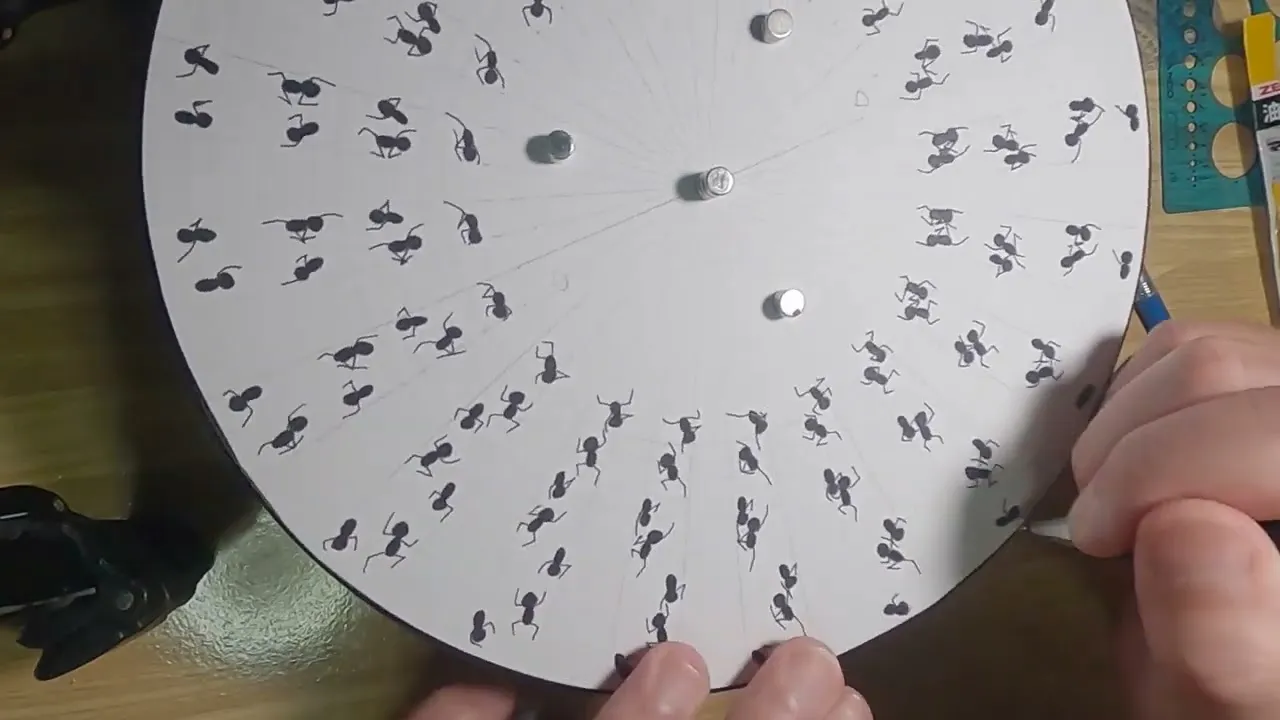
The phenakistoscope was obsolete by 1840, beaten by photography and then buried by film. Yohei Kisanuki draws one anyway, ant by ant, and it still works.
The principle is nearly two centuries old and has not improved since: draw a sequence of figures in a ring, each a few degrees further into its stride than the last, spin the disc, and interrupt the view — with slots, a shutter, or a camera’s frame rate — so the eye sees discrete positions instead of a smear. The brain fills the gaps. Kisanuki’s disc, titled 蟻人間, holds rings of small black ant-men in mid-march. On the turntable they stop being drawings and start walking.
What makes it worth watching is not the reveal but the labour behind it. The long video is the drawing: hours of hand, pen and paper, one figure at a time, each one placed by eye against the one before it. There is no software easing the motion, no onion-skinning, no way to preview whether the walk cycle reads until the disc is finished and turning. Every animator’s decision has to be made in advance and drawn in ink. The illusion is assembled in front of you, and you can watch it fail to look like anything until, quite suddenly, it does.
Kisanuki is a professional kalimba player by trade — LimbaTrip on YouTube, where most of the channel is thumb-piano performance — which makes the phenakistoscopes a sideline pursued at considerable cost in wrist. He has drawn others: climbers, dancers, walkers. The rhythm connection is not a stretch he makes himself, so we will not put words in his mouth, but a musician’s tolerance for repeating a small figure with tiny variations is visible in every ring.
The one caveat is practical. A phenakistoscope is a physical illusion and a video of one is a recording of it — you are watching the camera’s shutter do the interrupting, not your own eye. The effect is real either way, but the actual object, seen in a room with a strobe or a mirror, is a different and better experience. Kisanuki is a long way away, and this is as close as most of us will get. It is close enough.