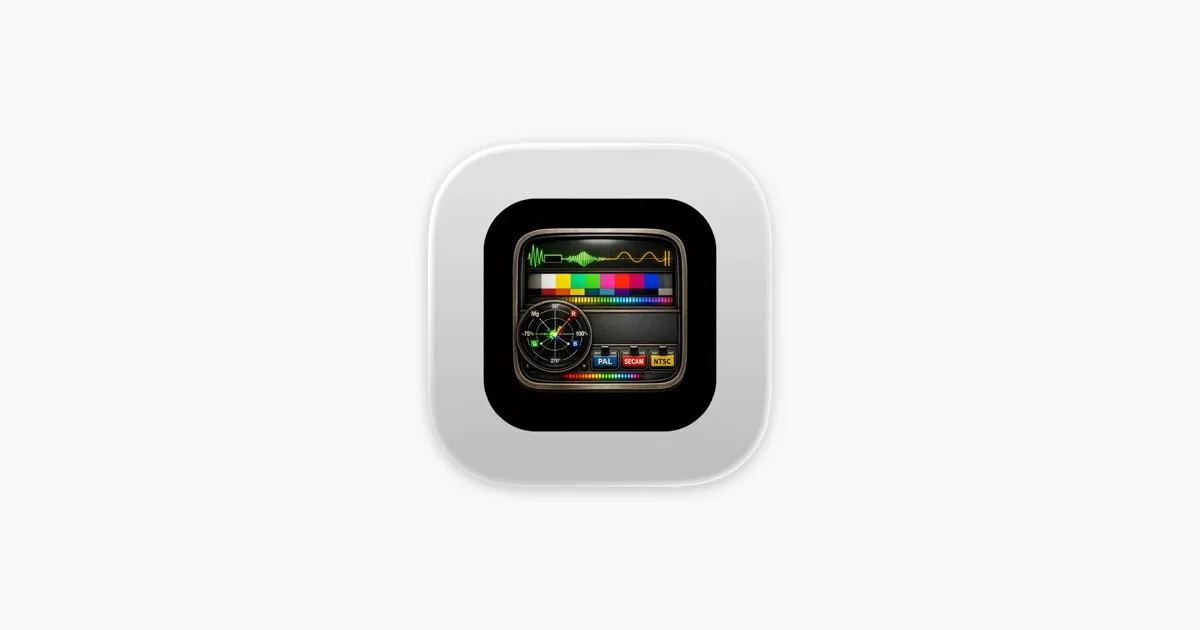
Not a scanline overlay — a simulated signal path, breaking up the way a real broadcast did.
Most “retro TV” effects paint scanlines and static over your footage and call it a day. Analog TV Simulator instead rebuilds the whole analogue television chain — broadcast camera tube, composite encoding, RF transmission, and CRT phosphor — from physical first principles, so the picture degrades the way a real signal actually did.
The difference is the entire point. A filter guesses at the look of old TV; this simulates the mechanism that produced it. Because the artifacts fall out of a modeled signal path rather than a preset overlay, dot crawl, color bleed, ringing, and ghosting behave the way they did on the specific system you pick — and they change correctly the moment you switch standards.
And there are a lot of standards: fourteen. The familiar NTSC, PAL, and SECAM, but also NTSC-4.43, PAL-60, and SECAM-L; the D-MAC and D2-MAC satellite formats; Japan’s MUSE/Hi-Vision and Europe’s HD-MAC, the dead ends of analogue HDTV; the ancient 405-line System A and 819-line System E; and — the tell that this is a labor of obsession — NASA’s Apollo lunar television, in both its slow-scan and field-sequential-color variants.
The depth keeps going past the signal itself. You choose among eight phosphor types (P22, P31, P7 and friends) and four camera-tube models with authentic lag, open a service menu of engineer-level controls, wave a virtual magnet at the screen and degauss it, and generate fourteen live test patterns. It renders on the GPU through Metal at 60fps, exports video in several codecs, runs a working teletext system with live pages, does NDI network video in and out, and can even take its picture from built-in arcade games like Pong and Space Invaders. It is closer to a software CRT than a filter plugin.
The honest framing: this is a $4.99 Mac-only app (macOS 14.6 or later, with a $9.99 in-app purchase for the NDI I/O), and it is gloriously niche. If the phrase “field-sequential Apollo color” made you sit up, you already want it; if you just need a quick VHS look over one clip, a preset filter will do and this is far more machine than you need. But that is exactly what makes it worth the look — an app built by someone who cared about getting the physics right, not just the vibe, and still actively refined (version 2.6 shipped this week).