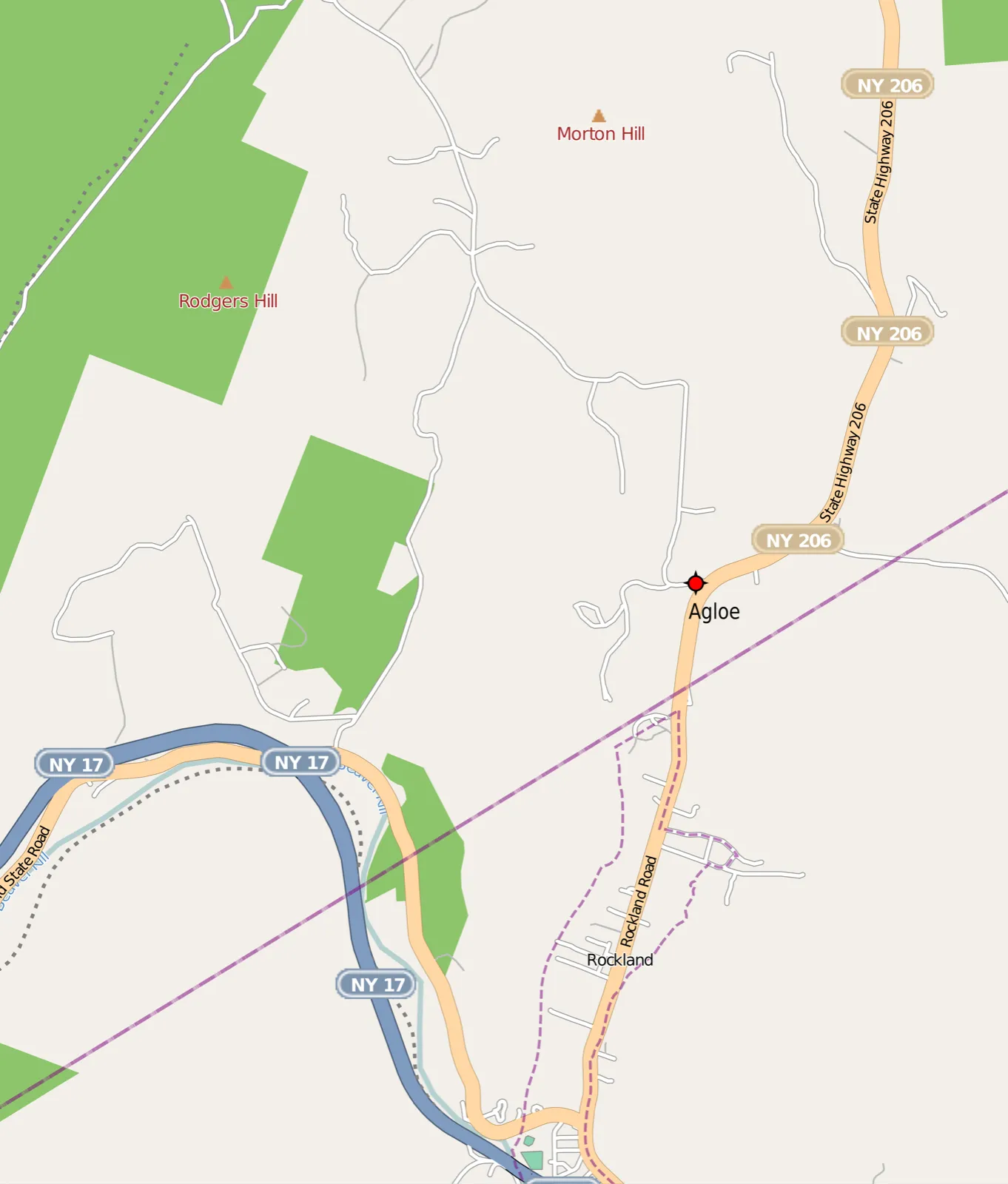
Two cartographers cannot independently invent the same fake town — which is why one of them planted Agloe on a map, and why the story of what happened next is only about half verifiable.
The logic of the copyright trap is airtight. Two mapmakers surveying the same county will draw the same rivers and the same roads, so a shared feature proves nothing. But a settlement that never existed can only get onto a rival’s map one way. Around 1925, Otto G. Lindberg and his assistant Ernest Alpers of the General Drafting Company — who made the road maps distributed by Esso — put a dot at an empty junction in the Catskills and labelled it Agloe: their own initials, O.G.L. and E.A., shuffled.
Then the trap sprang the wrong way. In 1930 a company called Agloe Lodge Farms was incorporated, acquired a fishing lodge nearby and named it the Agloe Lodge. A thing invented so that it could be proven not to exist had acquired a business address.
Here the record thins, and it is worth being straight about where. The version that circulates — that Rand McNally later printed Agloe, that General Drafting sued, and that Rand McNally won by pointing at the Agloe General Store as proof the place was real — is a good story that the documentation does not carry. Wikipedia’s account, sourced to the cartographer Frank Brown, has Rand McNally answering that its information came from Delaware County records, which was enough to head off action. Local residents dispute that a general store ever stood there at all. Several links in the popular chain are marked as uncited.
That leaves the durable part, which is strange enough without embellishment. A dot placed to catch a thief attracted a business that took its name from the dot. The name then propagated through county records and later through digital maps, and Agloe kept appearing and disappearing from Google Maps decades after anyone had a reason to draw it. Nothing was ever built to make Agloe real. It simply got referred to enough times.
The find’s framing — a lie that became a place — survives the fact-check. The courtroom flourish everyone repeats does not, and the version without it is the better one: no verdict, no clever lawyer, just a name that outlasted its own purpose because paperwork is a kind of existence.