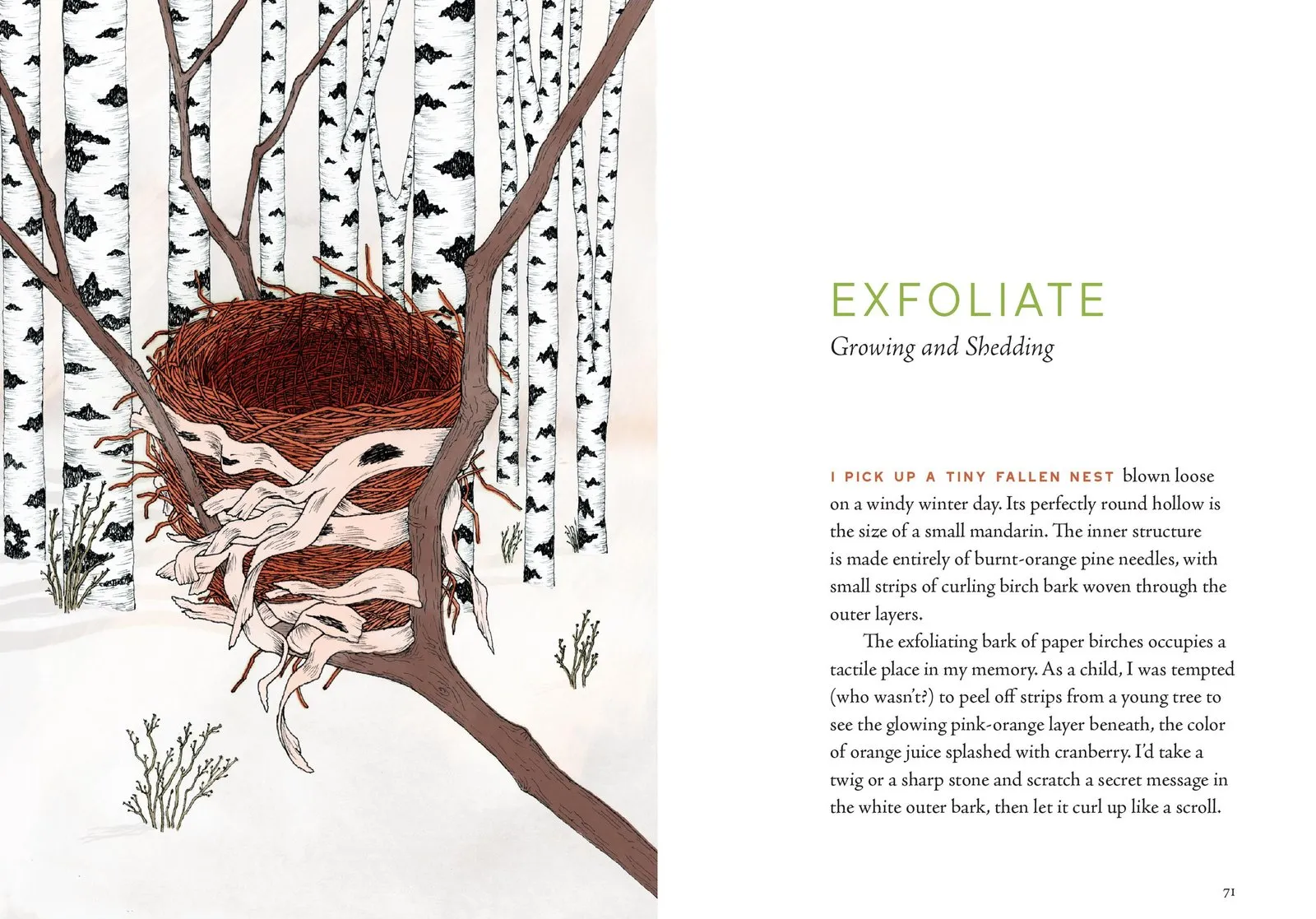
The “Exfoliate” spread, pages 70–71. Illustration by Henrike Lendowski; sample spread from the publisher, Storey.
Sixty-one words from forest science, each given two or three pages that are part definition, part essay. It reads like a walk with someone who can name everything in the woods and tell you why the name fits.
Every entry gets a word and a subtitle, and the pairs are the table of contents’ quiet pleasure: Gemel, “Joined at the Wound”; Krummholz, “The Crooked Wood at Treeline”; Marcescence, “Still Holding Fast”, for the dead leaves some oaks and beeches keep all winter; Wolf Tree, “The Lone Sentinel”. Taproot is “The Myth of Digging Deeper”. The book moves in four parts, Seed & Root, Growth & Repair, Leaf & Blossom and Kinship & Resilience, from preforest (“the time and space between forest and forest”) to refugium.
The definitions are exact, and then Fries keeps going. Whorl is a ring of branches radiating from one level of a conifer’s trunk, “making a springy resting place for fresh snow”. Exfoliate opens with a fallen nest the size of a small mandarin, woven from burnt-orange pine needles with strips of birch bark through the outer layers, and then goes back to her childhood, scratching messages into birch bark and letting it curl up like a scroll. Rhizosphere, the few millimetres of soil around a root, is “a world that hums, pulses, nearly glows with activity”.
Henrike Lendowski’s colour illustrations face many of the entries: a root system trailing pale root hairs across an ochre wash, locust blossoms hanging over a peach sky, a birch forest behind the nest. The book is a 176-page hardcover at $22, from Storey.
Two things to know. It is out on 29 September, so today it is a preorder. And the recommendation is not arm’s-length: Maria Popova, whose Marginalian essay surfaced it, wrote the foreword, has published Fries’s prose, and is in conversation with her at McNally Jackson in New York on publication day. Fries is also an executive editor at Storey, the book’s publisher. None of that changes the words, but it is worth knowing where the praise comes from. This review is based on the publisher’s sample spreads and the passages Popova quotes, not a full read.
Also on Amazon ↗ Affiliate
Affiliate link — we may earn a commission from qualifying Amazon purchases at no extra cost to you.